On October 27, 2026, the Speak Arizona podcast, from District 3 Toastmasters, published my conversation with host Rupesh Parbhoo about storytelling for leaders. We talked about the point where expertise stops being enough, what executive presence means, and the six steps that turn a personal story into a leadership tool: setup, buildup, scene, resolution, personal lesson, and audience theme. The full episode is below, followed by the parts I'd most want you to take away. Speak Arizona also wrote up the conversation on their site.
The full episode, 54 minutes. The time beside each quote below plays that moment here.
When expertise isn't enough
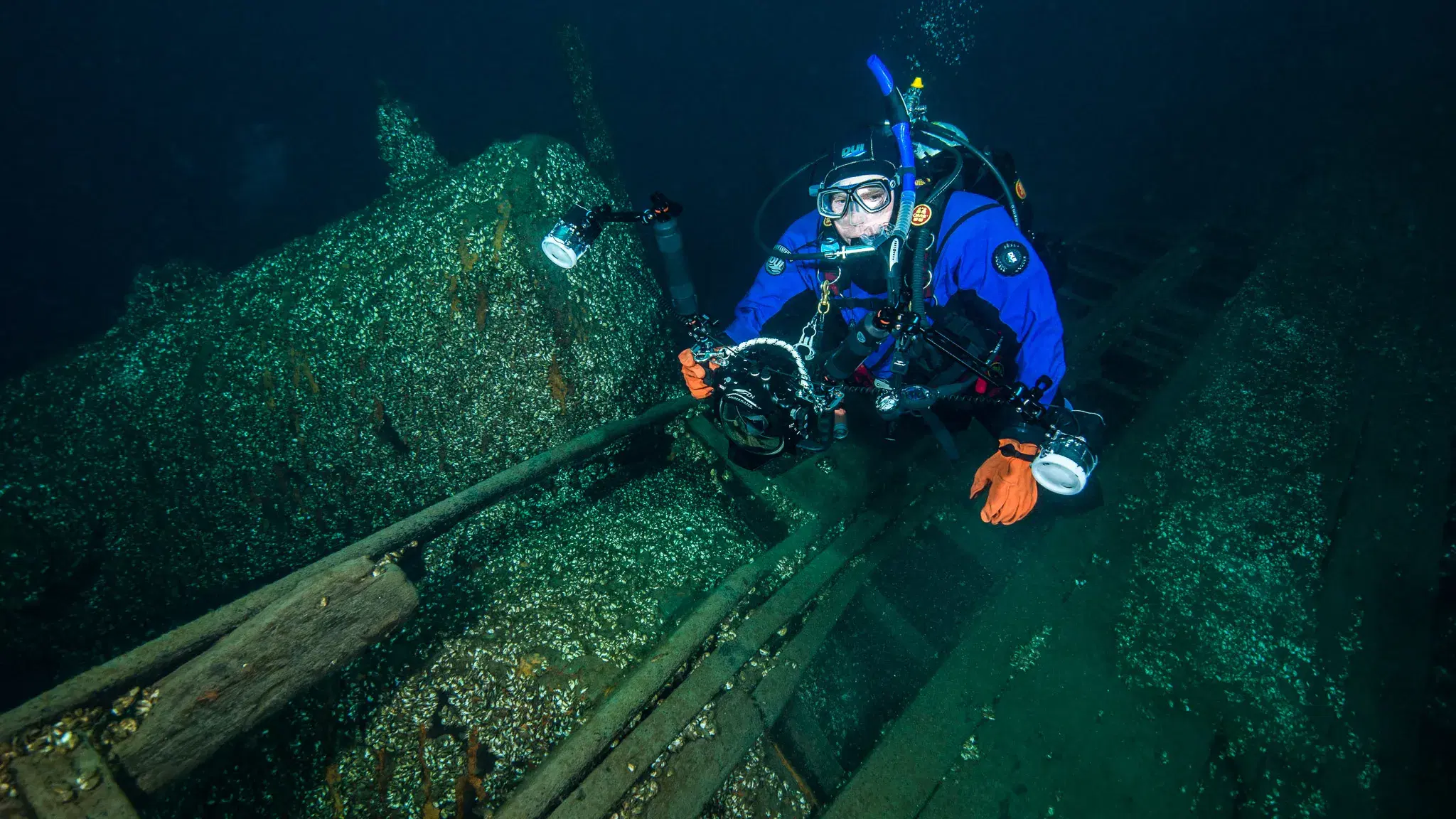
Rupesh asked what trips up accomplished leaders, and I answered with a story. On a dive to the Forest City wreck in Tobermory, Ontario, my regulator started leaking air at 118 feet, in fresh water cold enough to freeze it. I got my buddy's attention, he gave me his spare regulator, and we made our way slowly to the surface. On the boat afterward, this is what stayed with me.
It occurred to me that sometimes, you know, when the degree of difficulty gets high enough, all of our expertise, all of our training, all of our practical wisdom is absolutely necessary. But it ain't enough. We need something more. 6:59
On the ride back to shore, I saw the connection to leadership.
I realized, gosh, that's a lot like this inflection point that we reach as leaders where suddenly our functional expertise as accountants, as marketers, as finance professionals, whatever, gets us to a certain point, right? But it ain't enough. It ain't enough. And we need something else. 7:27
What executive presence is
So what is that something more? We call it executive presence, and the words that matter most in the definition are "as viewed by others."
We defined executive presence as the attributes of a leader, parenthetical, as viewed by others. That's huge. The attributes of a leader as viewed by others that engage, align, and inspire others to act. 10:05
I learned the shorthand for it more than 20 years ago, from an old boss in New York.
He said, Batesy, who cares what you think? It doesn't matter what you think. 14:53
Why stories work
Storytelling is one of the tools for building executive presence. Stories show behaviors and values, and the most important thing they do is force you to reflect.
We don't learn from experience. We learn from reflecting on experience. 18:40
The six steps
These are the six steps I walked through in the episode, for a story that has a particular audience in mind:
- Setup. Paint a picture so your audience gets curious.
- Buildup. Add tension, and a hint that something is about to go wrong.
- Scene. The peak of the action.
- Resolution. What happened next. People often forget this one.
- Personal lesson. What you personally learned from the experience.
- Audience theme. Turn your lesson outward, into something your audience can use.
If we stopped right there after the resolution, those four steps, that would make a great dinner party story. … It's the next two steps that are absolutely mandatory for a leadership context. 25:42
The hero and the village idiot
The steps sound simple, and they can be tricky. The most common slip is running the personal lesson and the audience theme together, or leaving the theme out.
One of the guiding principles of storytelling is that you never want to be the hero of your own story. You want to be the village idiot. And I'm not exaggerating by much, right? You want to be the village idiot. And that's important because we learn more from our failures, right? And if we can share our failures and our vulnerabilities, vulnerability is a huge lever in trust. 28:11
Three minutes
Whether it's a story for leadership or a business case for a million dollars, the time limit is the same.
We teach them how to do it in three minutes, three minutes. If you go beyond three minutes, you exceed the average human's attention span. 20:34
I go long myself sometimes, because I get caught up in my own story. The fix is in the edit.
The hardest part of the story is editing it down to only the important bits that are relevant to your audience to get it into the three minutes. They don't need to know everything. They just need to know the most important stuff. 29:19
Build a story kit
People often tell me they don't have any stories.
A buddy of mine, a peer of mine used to love to say, dude, if you're breathing, you've got stories, right? 37:04
They don't even have to be your own. I've borrowed stories, among them my grandfather's story of photographing FDR, and it took me years to see what it meant. The habit that makes the difference is catching ideas when they come.
The most important thing you can do is make a story kit and just start capturing ideas. … If you don't put them in notes or an Evernote, when you think about them, when you're walking down the street, they will evaporate. Ask me how I know. 37:54
Ask for advice, not feedback
Near the end, Rupesh asked what someone could start doing on Monday morning. My answer went past storytelling to leadership itself. Ask a peer, a direct report, your boss, or your boss's peer how you could be a more effective leader.
The key word here, and this is really important, you want to ask for advice. People love to give advice. They hate to give feedback. I'll say that again. They love to give advice. They love to be an expert. They hate giving feedback. So don't ask for feedback. 41:06
I'd add regular one-on-ones with your peers, asking how you can be a better partner.
It's not about you
When he asked if there was anything else before the rapid-fire questions, this was it.
I mean, probably the single most important thing here is that it's not about you. … Yes, storytelling is important. It's a great tool. But the reasons we use it, you know, have nothing to do with you and have everything to do with how others feel about you. And are they moved to act? 44:28
Speak Arizona's short from the episode.
Thank you
Thanks to Rupesh and the Speak Arizona team, and to District 3 Toastmasters, which powers the show. More about my work as a leadership consultant and photographer is on my About page.